 The A-Level English Guide
Do you know where most of the marks are?
Exam-ready English, one skill at a time.
Clear, structured revision for AS and A Level English Language (9093), built on what the mark schemes actually reward.

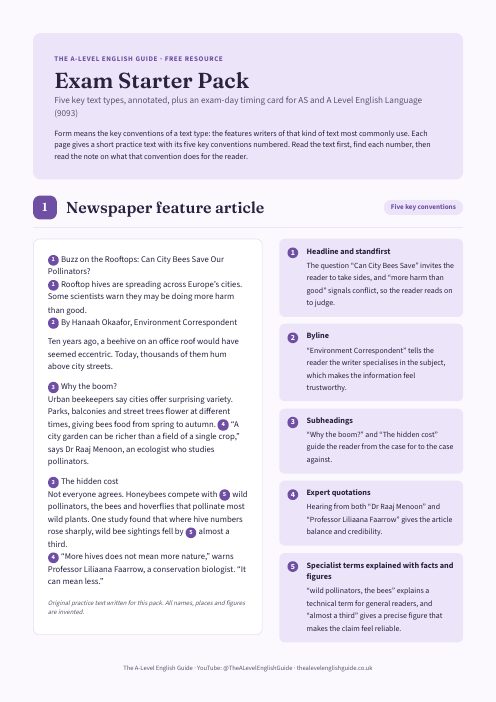
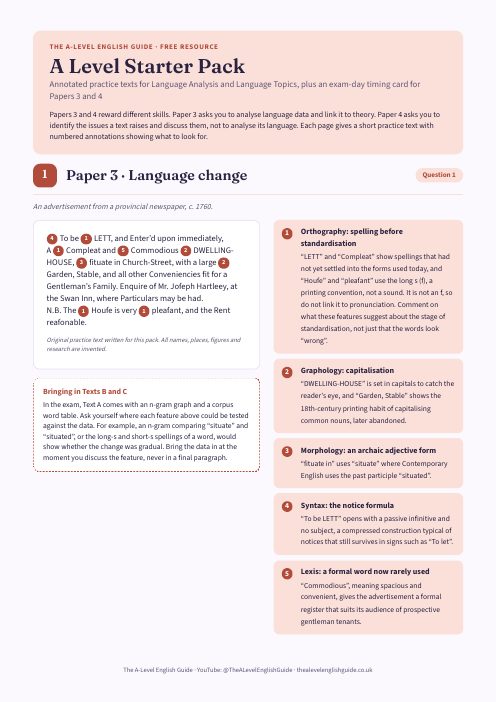
Free download
Get your free Starter Pack
Choose the AS pack (Papers 1 and 2) or the A Level pack (Papers 3 and 4). Each has annotated practice texts and an exam-day timing card. Sign up and download yours straight away.
What makes this different
Revision that follows the marks
Built on the mark scheme
Every tip, checklist and model answer is grounded in mark schemes, examiner reports and example candidate responses. No generic advice.
Analysis, not feature-spotting
Naming a feature earns nothing on its own. Each video shows you how to move from identification to analysis that scores.
Not sure where to start?
Start here
Pick your level, then watch the videos in order.
New to AS Level English Language? Watch these three in order.
- 1
Context, Audience and Purpose Explained: Full Guide (AS Level English)
Every analysis starts with what a text is for and who it is for.
Watch → - 2
How to Analyse an Article: A Full Walkthrough | 9093 Paper 1 Q2 (Level 5 Model Answer)
See form, structure and language worked through on a full practice text.
Watch → - 3
Paper 1 Q2: How to Analyse Language Devices Full Worked Example
Learn to turn a device into analysis that scores.
Watch →
Moving on to A Level? Start with these four.
- 1
How to Answer Paper 3, Question 1: Language Change
Learn to combine all three texts in one analysis.
Watch → - 2
How to Analyse Child Language Acquisition: Paper 3, Question 2
Work through the child language data question.
Watch → - 3
Complete Theory Guide: Paper 4
The theories for both Paper 4 topics in one place.
Watch → - 4
Paper 4: How to Ace Language Topics (Discursive Essay Guide)
Turn the stimulus text into a discursive essay that earns AO1 and AO4 marks.
Watch →
Browse by paper
English Language (9093)
Papers 1 and 2 open the AS Level playlist; Papers 3 and 4 open the A Level playlist.
Reading
Text analysis and comparison
See videos → 2Writing
Shorter writing, reflective commentary and extended writing
See videos → 3Language Analysis
Language Change and Child Language Acquisition
See videos → 4Language Topics
English in the World; Language and the Self
See videos →Building your own writing? Try The Writer’s Toolkit playlist.
Exam time planner
Know exactly where your time goes
Choose your paper, type in your start time and get a minute-by-minute plan you can copy onto your question paper.
Suggested timings, split roughly by marks. Exam lengths and marks follow the 2027 to 2028 syllabus.

Test yourself in 60 seconds
Form, structure or language?
Students lose marks by putting features in the wrong part of their answer. Choose an answer on each card to check yourself.
A tricolon, like “faster, cheaper, and more precise”
Language. Three items grouped for rhythm, balance, emphasis and memorability.
Expert quotations in a newspaper article
Form. They are a key convention of the text type.
Foreshadowing
Structure. It depends on how events are ordered and revealed.
A paradox, like “silence is never silent”
Language. Its effect comes from word choice.
A circular ending
Structure. It is about how the whole text is organised.
The byline in a newspaper article
Form. It is a key convention of the text type.
Two devices, four words
Can you spot both?
“silence is never silent”
This four-word line from a novel extract hides two language devices.
- Paradox
- “Never” denies silence its own defining quality, so the line seems to contradict itself.
- Polyptoton
- The same root returns in a new grammatical form, first a noun, then an adjective.
Figurative devices
The familiar and the rare
Figurative language is language where the meaning goes beyond the literal. Tap a card to see what each device is and what it does.

Sound devices such as alliteration, sibilance and onomatopoeia are language features too, but they work through sound rather than figurative meaning, so they are not included here.
Read the guide on analysing language devices. All 21 devices, with full extracts and practice, are in the Language Devices Handbook: Text Analysis - Reading.
Mistakes examiners see
Four habits that cost marks
Examiner reports point to these again and again. Each one has a quick fix.
Listing techniques without an example or explanation.
Name the feature, quote it, then explain its effect on the reader.
See how in the guide →Vague effects, such as “to paint a picture” or “creating an interesting image”.
Use precise terminology and say exactly what the reader sees, feels or notices.
See how in the guide →Quoting at far too great a length.
Keep quotations precise and short. Five words or fewer is usually enough.
See how in the guide →Pointing out sentence types or paragraph lengths with no reference to effect.
Explain what that choice does for the reader.
See how in the guide →
Revision guides
Read, save, come back to
Short, focused written guides you can read, save and come back to before the exam. Each one links to its video.

Identification is not analysis: how to write about a language device so it earns marks
Spotting a device is only the starting point. This guide shows you how to turn it into analysis that examiners reward.
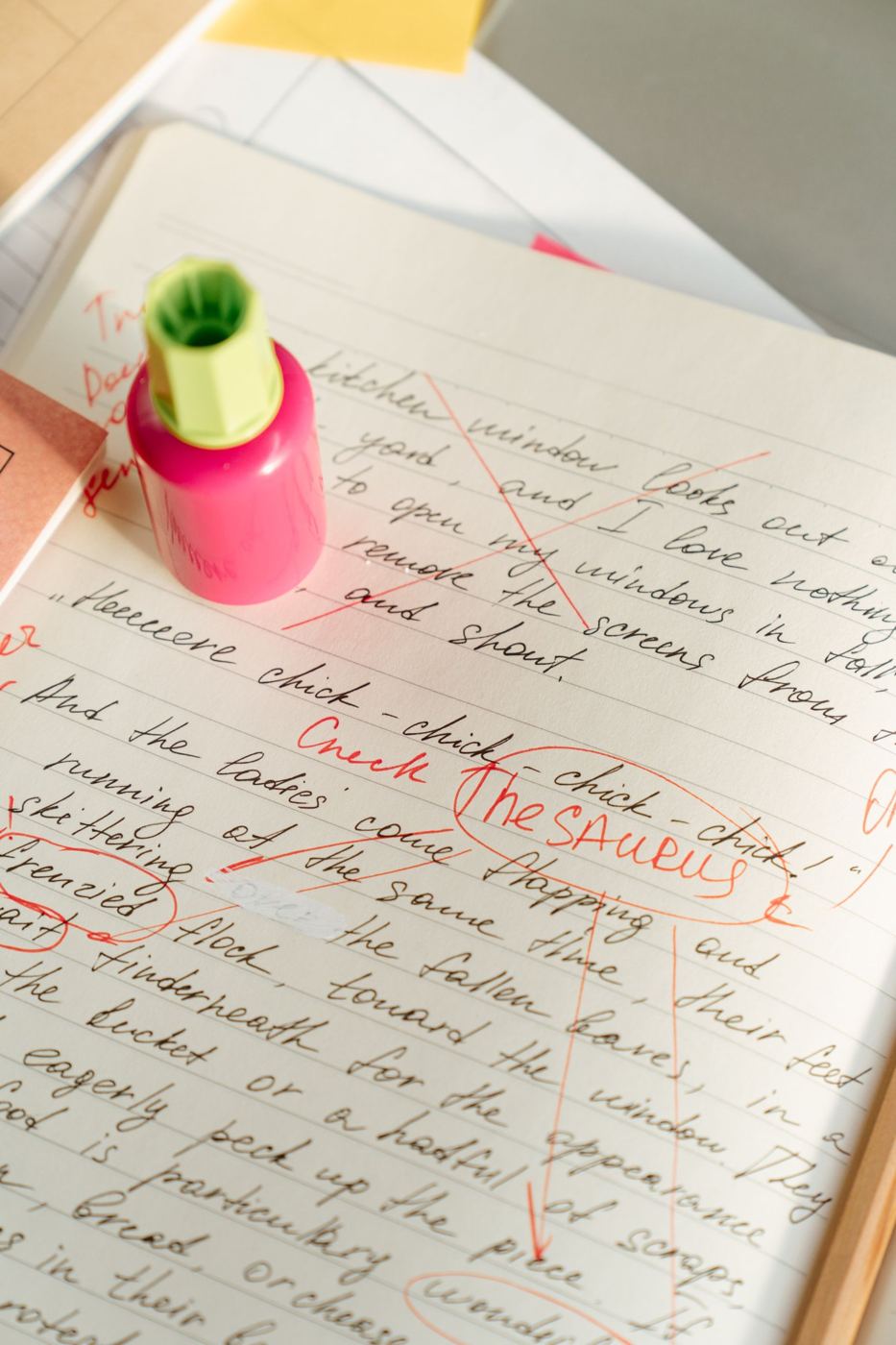
How to write about form: the key conventions of a newspaper article
Form is the text type itself. Learn the five conventions to look for in a newspaper article, and how to turn each one into analysis.

How to use language devices in your own writing: a seven-step process
Knowing devices is one thing; using them well is another. See five devices at work, then follow seven steps to create any effect a task asks for.

Language change: how to use all three texts together
Question 1 gives you three texts and one essay. This guide shows you how to synthesise them, use the data properly and anchor every theory to evidence.

Paper 4: how to write a discursive essay, not a language analysis
Paper 4 rewards thinking linguistically about issues, not analysing how the stimulus text is written. This guide shows you how to use the text, theory and structure to reach the top band.
Latest videos
New on the channel

9093 Paper 2 Q1b How to Write a Top Band Reflective Commentary
Watch on YouTube →
How to Analyse an Article: A Full Walkthrough | 9093 Paper 1 Q2 (Level 5 Model Answer)
Watch on YouTube →
Context, Audience and Purpose Explained: Full Guide (AS Level English)
Watch on YouTube →
Resources
Go further with the handbooks
Language Devices Handbook: Text Analysis - Reading
21 language devices, explained with real extracts, model analysis and practice on every page.
See it on GumroadThe Language Devices Handbook: Writing Companion
A step-by-step guide to writing with purpose, using the same seven-step process as the videos, with model answers at the back.
See it on GumroadAbout
About the guide
The A-Level English Guide is written by an AS and A Level English Language examiner with over 30 years in English language teaching, including university-level teaching and a specialist postgraduate teaching qualification. The aim is simple: to turn assessment criteria into clear, practical steps you can use in the exam room.
Support
Find this helpful?
Subscribe on YouTube, share the videos with a classmate, or buy me a coffee to help keep the content free.